The Challenge
How do you teach adults to see the interconnected systems that shape our world—economic inequality, environmental degradation, social justice—without overwhelming them or reinforcing the very hierarchies you're trying to critique?
The Northwest Earth Institute—NWEI—needed a discussion-based curriculum on peace, justice, and sustainability for use in college classrooms, workplaces, and religious institutions. The course needed to:
- Address complex, emotionally charged topics—systemic racism, economic inequality, climate change—in ways that fostered dialogue rather than division
- Center equity and justice without alienating learners unfamiliar with these frameworks
- Work across diverse contexts—secular workplaces, faith communities, academic settings
- Support facilitators who might not be subject-matter experts
- Invite self-reflection rather than prescribing "correct" answers
This wasn't just curriculum development. That is, it was designing learning experiences that challenged assumptions while maintaining psychological safety.
My Role
I served on the Curriculum Development Committee and in an editorial capacity for this 6-session discussion course. My responsibilities spanned content creation, editorial oversight, and production logistics:
Curriculum Development
- Participated in committee meetings to shape course structure and learning objectives
- Contributed to session design and discussion prompt development
- Wrote ancillary content (facilitator notes, discussion guides, reflection activities)
- Reviewed draft materials for clarity, accessibility, and alignment with equity principles
Editorial Responsibilities
- Copy editing - Ensured clarity, consistency, and adherence to style guidelines across all sessions
- Permissions management - Negotiated permissions contracts for third-party readings, images, and excerpts
- Content review - Verified citations, fact-checked claims, and ensured intellectual rigor
- Accessibility review - Flagged jargon, clarified complex concepts, and ensured materials worked for diverse audiences
Production Support
- Coordinated with designers on layout and visual elements
- Reviewed proofs for errors introduced during typesetting
- Managed version control across multiple contributors
This was my first experience with equity-centered curriculum development, and it profoundly shaped how I approach instructional design.
Course Structure
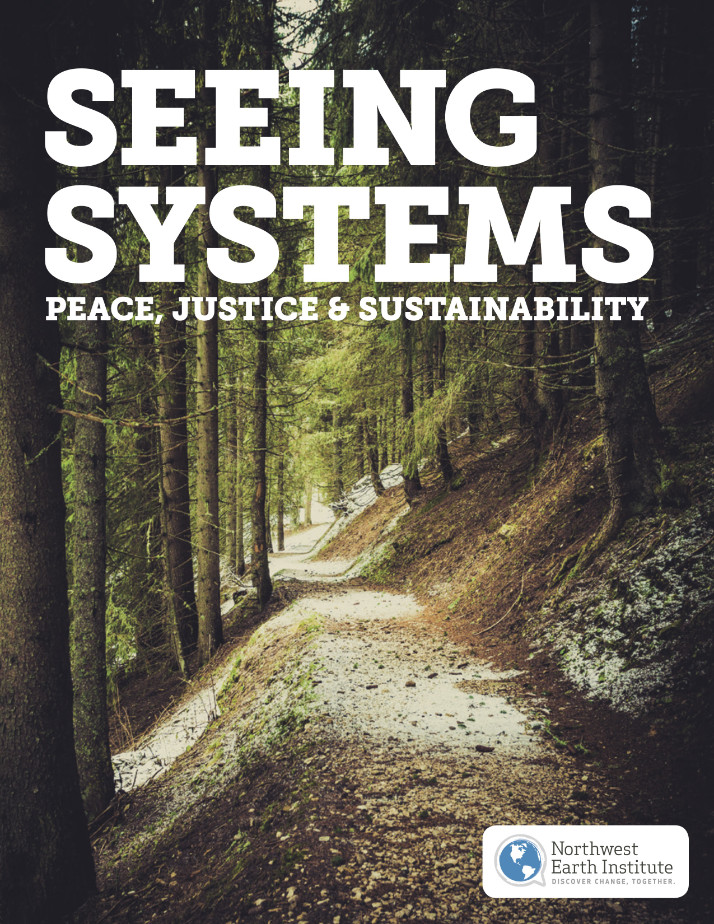
Seeing Systems: Peace, Justice, and Sustainability is a 6-session discussion course designed for small groups (6-12 participants) meeting over 6 weeks. Each session follows a consistent structure:
Session Format
Pre-Session Reading (30-45 minutes)
- Curated articles, essays, and excerpts from thought leaders in systems thinking, social justice, and sustainability
- Reflection prompts to guide individual thinking before group discussion
Group Discussion (90-120 minutes)
- Opening question to set context and build community
- Facilitated discussion exploring session themes
- Reflection activities (journaling, pair-share, group mapping)
- Closing circle to synthesize learning
Post-Session Actions
- Optional commitments to apply insights in daily life
- Suggested resources for further learning
Course Themes
The six sessions build on each other, moving from personal awareness to systemic understanding to collective action:
- Introduction to Systems Thinking - Learning to see interconnections and feedback loops
- Justice and Equity - Understanding how systems perpetuate inequality
- Economic Systems - Exploring capitalism, consumption, and alternative economic models
- Environmental Systems - Climate change, resource depletion, and ecological justice
- Peace and Conflict - Violence as a systems problem; pathways to peace
- Moving Forward - Personal and collective action; sustaining hope and momentum
Each session integrates perspectives from diverse voices—Indigenous knowledge holders, environmental justice advocates, economists, theologians, and community organizers.
Design Principles
1. Questions Over Answers
The curriculum doesn't prescribe "correct" positions on complex issues. Instead, it poses generative questions:
- "What systems benefit from current economic structures? Who is harmed?"
- "How do our personal choices connect to global systems?"
- "What would justice look like in your community?"
This approach respects adult learners' autonomy and invites them to construct meaning rather than passively receive it.
2. Multiple Entry Points
Materials work for learners with different backgrounds:
- Faith-based groups can explore theological connections to justice and sustainability
- Workplace groups can examine organizational systems and decision-making
- Academic settings can dive deeper into theory and research
Facilitator guides offer variations for different contexts, but the core content remains flexible.
3. Equity-Centered Design
The curriculum explicitly addresses power, privilege, and marginalization. Key strategies:
- Centering marginalized voices - Readings prioritize authors from communities most impacted by systemic injustice
- Naming systems, not just symptoms - Instead of "poverty," we discuss "economic systems that produce and perpetuate poverty"
- Acknowledging discomfort - Facilitator guides include language to normalize the discomfort that arises when examining privilege
- Inviting self-reflection - Discussion prompts encourage learners to examine their own relationship to systems of power
4. Psychological Safety
Discussing systemic racism, economic inequality, and environmental destruction can evoke strong emotions—guilt, anger, defensiveness, despair. The curriculum builds in structures to hold that complexity:
- Community agreements (established in Session 1) to create brave spaces for difficult conversations
- Reflection activities that allow processing before public sharing
- Facilitator guidance on managing conflict, supporting learners in distress, and balancing advocacy with dialogue
Editorial Challenges
Permissions Management
One of my primary responsibilities was securing permissions for third-party content. This involved:
- Identifying copyright holders for articles, book excerpts, poems, and images
- Negotiating fees within NWEI's nonprofit budget constraints
- Drafting permissions requests that explained the educational, nonprofit mission
- Tracking correspondence across 30+ permissions requests
Challenge: Many powerful essays on justice and sustainability were written by independent scholars, activists, or community organizers whose work wasn't formally published. Tracking down authors and negotiating permissions required persistence and relationship-building.
Learning: Copyright law is complex, and permissions take time. I learned to build permissions timelines into production schedules and to develop templates that streamlined requests.
Copy Editing for Accessibility
The curriculum needed to be rigorous enough for academic use but accessible enough for workplace discussion groups. This required careful editing:
- Defining jargon - Terms like "systemic racism," "neoliberalism," and "intersectionality" needed clear, accessible definitions without oversimplifying
- Balancing depth and clarity - Complex ideas needed unpacking, but we couldn't dilute the content
- Fact-checking - Claims about economic systems, environmental data, and historical events required verification
Example edit:
Original draft:
"Neoliberal economic policies prioritize market efficiency over social welfare, exacerbating inequality."
Edited version:
"In recent decades, many governments have adopted economic policies that prioritize free markets and reduced regulation (sometimes called 'neoliberalism'). Critics argue that these policies increase inequality by weakening social safety nets and concentrating wealth among elites."
The edited version defines the term, provides context, and attributes the claim to "critics" rather than stating it as fact—inviting discussion rather than foreclosing it.
Balancing Multiple Voices
The Curriculum Development Committee included educators, theologians, environmental scientists, and community organizers. Each brought valuable perspectives—and different priorities.
Tension example:
- Faith-based contributors wanted explicit connections to religious texts and traditions
- Secular contributors worried that religious framing would alienate workplace groups
Resolution: We created a core curriculum that worked across contexts, with optional supplements for faith-based groups. Facilitator guides included theological reflection prompts as add-ons, preserving flexibility.
This taught me the value of modular design—building adaptable materials rather than trying to make one version serve all contexts perfectly.
Impact
Broad Adoption Across Contexts
Seeing Systems has been used in:
- College courses (environmental studies, theology, sociology, peace studies)
- Workplace learning circles (nonprofit organizations, social enterprises)
- Faith communities (churches, synagogues, meditation groups)
- Community organizing (environmental justice groups, neighborhood associations)
The curriculum's flexibility and equity-centered approach made it adaptable to diverse settings.
Long-Term Use
The course was published in 2014 and remains in circulation over a decade later, demonstrating the durability of well-designed discussion-based curricula. NWEI continues to offer it as part of their catalog.
Personal Impact on My Practice
This project fundamentally shaped how I approach instructional design:
1. Equity isn't an add-on—it's a design principle.
Before this project, I thought of equity as "diverse representation in examples" or "avoiding offensive language." Seeing Systems taught me that equity-centered design means:
- Centering marginalized voices in content selection
- Examining whose knowledge is valued and whose is erased
- Designing learning experiences that invite critical examination of power structures
2. Good curriculum asks better questions, not just provides better answers.
The most powerful sessions weren't the ones with the most information—they were the ones with the most generative questions. This insight influences how I design all learning experiences now.
3. Adult learners need space to construct meaning, not just receive it.
Discussion-based learning respects adults' lived experience and invites them to connect new ideas to their own contexts. Prescriptive, lecture-based approaches don't work for complex, value-laden topics.
4. Editorial rigor matters.
Copy editing isn't just "fixing typos"—it's ensuring clarity, accessibility, and intellectual integrity. Permissions management isn't just "legal compliance"—it's respecting creators' work and sustaining the ecosystem of ideas. These behind-the-scenes roles are foundational to quality learning materials.
What I Learned
Designing for Difficult Conversations
Systems thinking about justice and sustainability inevitably surfaces discomfort. Some learners feel guilt about their privilege. Others feel anger about how systems have harmed them. Some resist the premise altogether.
The curriculum's strength was in holding space for that complexity without trying to resolve it prematurely. Facilitator guides coached leaders on sitting with discomfort, validating emotions, and redirecting defensive energy toward curiosity.
Key insight: You can't design away discomfort in equity-centered learning. You can only design structures that help learners navigate it productively.
The Power of Slow Learning
In a world of microlearning and just-in-time training, this 6-week discussion course feels countercultural. But systems thinking requires time—time to read, reflect, discuss, sit with uncertainty, and revise assumptions.
Next time: I'd add asynchronous discussion options (online forums, reflection journals) for learners who need more processing time before speaking in group settings.
Modular Design Increases Adaptability
Building optional supplements for different contexts (faith-based, workplace, academic) made the curriculum more versatile than trying to create one "universal" version. This principle applies to all instructional design—design for the core, then build adaptable extensions.
Preview the Course
Session 1 of Seeing Systems: Peace, Justice, and Sustainability is available for preview:
Credits
Client: Northwest Earth Institute (NWEI)
Curriculum Development Committee: Collaborative authorship with educators, theologians, environmental scientists, and community organizers
My Contributions: Curriculum development, copy editing, permissions management, content review, facilitator guide development
Publication: 2014 (still in active use)